
Introduction
Two macro themes have emerged over the last three years that are reshaping European lawmaking and economic policy: (1) competitiveness and (2) geopolitics. These two themes have not developed in isolation from each other. Rather, they mutually reinforce how Europe envisions regulating the flow of goods and capital into and out of the single market.
This dual emergence marks a sharp departure from the post-Cold War consensus, when trade and security were treated as predominantly separate domains, with economic integration assumed to be a stabilising force rather than a theatre of strategic competition. Today, geopolitical competition is occurring principally through international economic policy instead of hot wars – though even that has begun to change. International economic policy serving as this primary dimension also then distinguishes the present era from the Cold War, when almost no trade or economic interdependence existed between the industrialised democracies and their primary rival, the Soviet bloc. What is more, Europe and the U.S. no longer operate as hegemons in the international system to the extent they did in the 1990s, and now face strengthening competitors for the promises of prosperity.
Political scientists Henry Farrell and Abraham Newman argue that 2025 signified the opening of the era of “weaponised interdependence”, which would “be shaped by weapons of economic and technological coercion – sanctions, supply chain attacks, and export measures – that repurpose the many points of control in the infrastructure that underpins the interdependent global economy.”1 Furthermore, Europe’s declining relative competitiveness is adding more pressure to reorient European regulatory and trade policy.
Competitiveness
The importance of enhancing Europe’s competitiveness has been urged by a series of proposals over the last two years. The most prominent was the Draghi report to the European Commission (“Commission”)2. The Letta report, as well as calls from industry and civil society,3 have reinforced that same necessity. The Commission responded with its Competitiveness Compass4 - a plan that covers the main areas identified by Draghi, albeit in much less depth5.
This priority shift has supported the omnibus proposals to simplify EU rules, the Industrial Accelerator Act, and a broader wave of measures aimed at EU competitiveness6. Results to date though show considerable room for future changes. An independent audit presented at Harvard University finds that of 383 recommendations in the Draghi report, only 60 (15.7%) are fully implemented to date, with a further 25.6% partially implemented7. Europe’s competitiveness reform agenda is therefore a story in progress, far from a concluded chapter. This uncertainty toward future economic and trade policy is broadly felt:
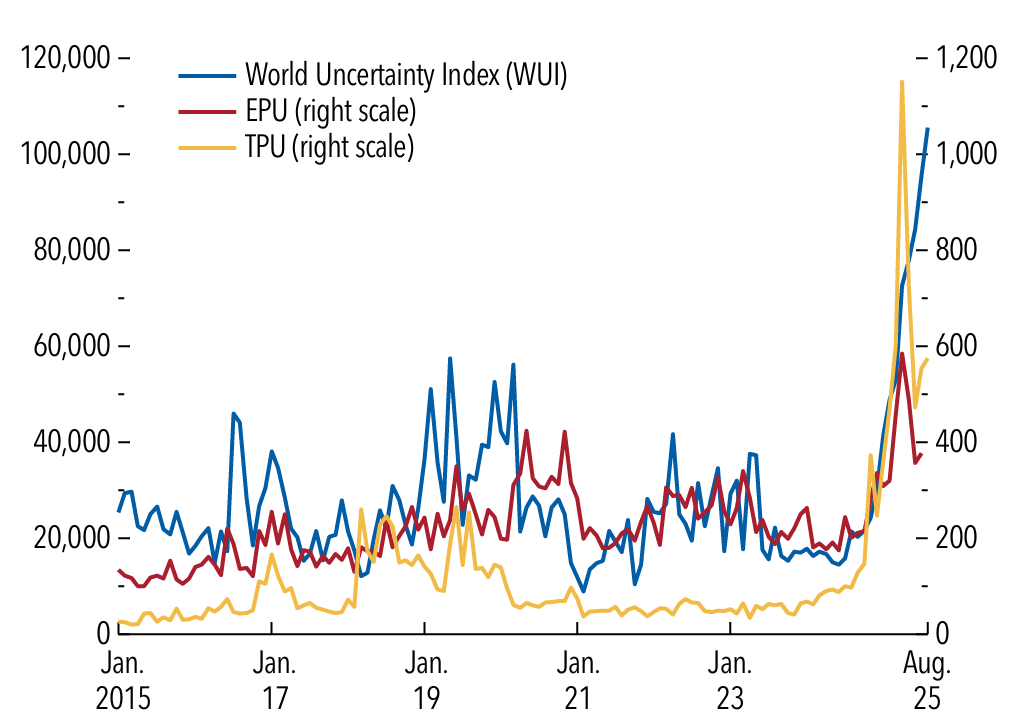 Note: These indices quantify media coverage. WUI captures overall uncertainty, EPU focuses on economic policy uncertainty, and TPU trade policy uncertainty.
Geopolitics
Europe has also been adapting to a new era of international politics. The post-Cold War period saw the consolidation of the EU and the spread of market democracies across Europe and much of the world9. This was accompanied by a sustained decline in European defence spending. However, both the spread of democracy and decreasing defence spending have reversed in recent years10. In addition, areas affected by armed conflict have grown by 89% since 202111.
International economic regulations have followed this macro trend of a more contested and fragmented world. From the COVID-19 pandemic onward, there has been a major rise in the use of instruments of economic statecraft:
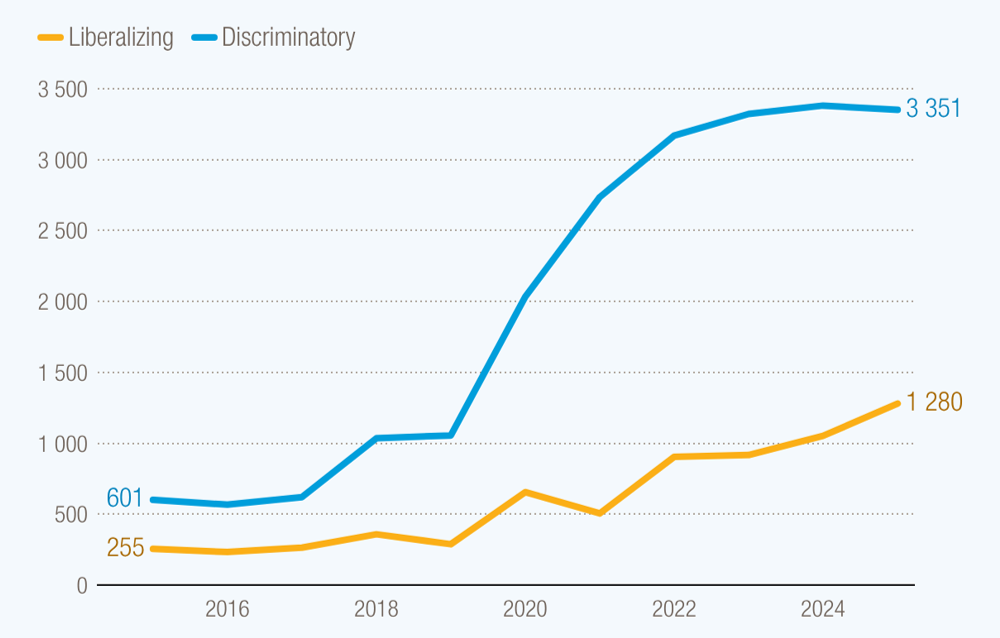 Source: UN Trade and Development (UNCTAD) based on Global Trade Alert.
In addition, European competition policy,13 trade law,14 data and privacy regulations,15 and democracy policy16 are all increasingly being leveraged to advance geopolitical objectives.
Globally, measures of adverse geopolitical events and associated risks have spiked since November 2021, making geopolitics an increasing driver of how businesses and markets operate:
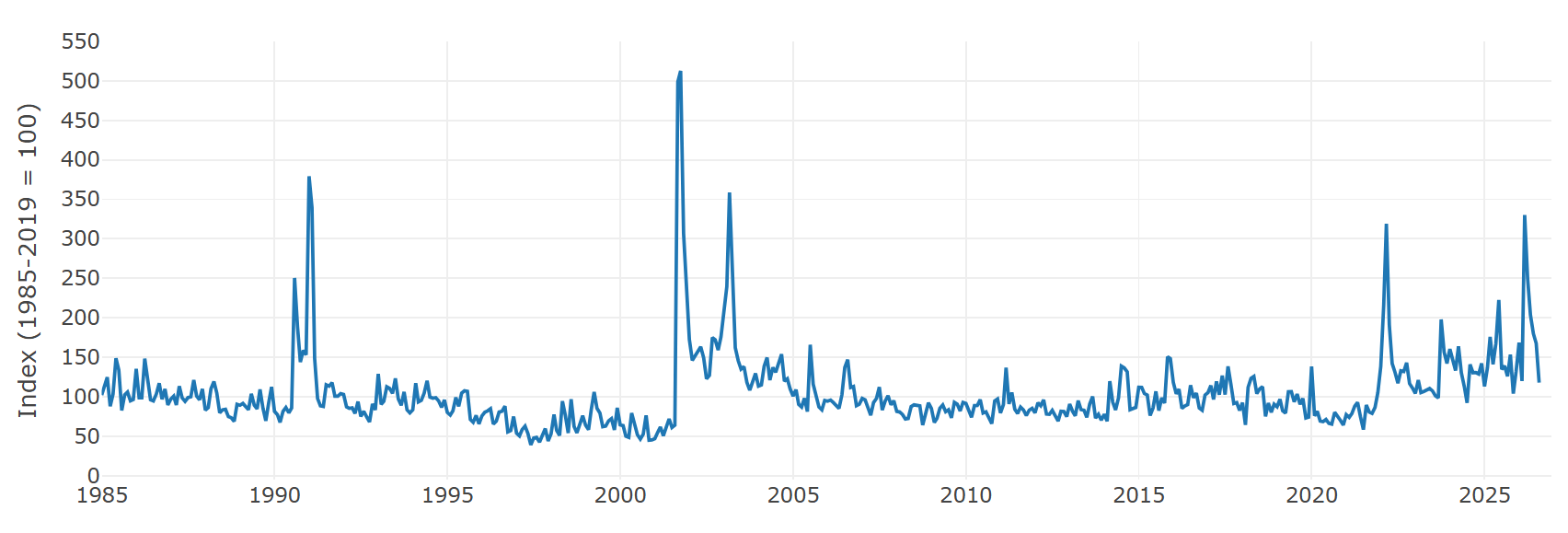 Note: The index draws on 10 major newspapers (e.g., Chicago Tribune, Daily Telegraph). Each month’s score reflects the share of news articles related to adverse geopolitical developments.
These clear global trends illustrate that security-driven regulatory policy will not be confined to Europe – and that will only reinforce Europe’s interest in re-prioritising its own resilience in an interdependent world.
From Risk to Strategy
The convergence of competitiveness and geopolitics within the EU has moved regulatory risk from what had often been at the periphery of corporate strategy toward its centre. This is especially the case in the domains of international trade and cross-border investment. Navigating this new environment is no longer a question of compliance alone. It calls for businesses to bring greater attention to legal and policy issues across how they plan, invest, approach public authorities, carry out due diligence, and transact.
To optimise competitive advantage in this emergent environment, businesses need proactive strategies. Companies which appreciate that international trade and investment are increasingly shaped by competitiveness policy and economic security considerations can turn this shift into a source for their own competitive advantage. The 12 recommendations that follow lay out strategies for consideration.
Recommendations for Business
- Build legal monitoring around the EU’s legislative calendar: EU trade and investment law rarely changes overnight. Proposals move through a visible sequence – Commission consultation, impact assessment, draft text, trilogue negotiation between Parliament and Council, and often a phase-in period of several months, with consultation windows open before a measure is finalised. Businesses that only pick up a development once it is adopted have missed every point at which they could have shaped it, prepared for it, or timed their own transactions around it. Rather than a general watch on legal and policy developments, companies should map this legislative calendar for the specific instruments bearing on their exposures and plan accordingly.
- Track and engage with the simplification agenda to capture compliance savings: The Commission aims to cut recurring administrative costs by EUR 37.5 billion by the end of its 2024-2029 mandate. Through its omnibus proposals and other legislative initiatives, reporting thresholds are shifting, phase-in dates are being pushed back, and certain obligations are being narrowed or dropped entirely. Companies that treat the simplification agenda as a legal update miss the opportunity it offers. Businesses should track these changes closely enough to adjust compliance programmes and budgets in real time, and, where relevant, inform the consultations to shape the rules.
- Evaluate the single market tailwinds for cross-border expansion: A recurring theme of the Draghi report and the Competitiveness Compass is that Europe’s construction into 27 legal regimes is a challenge to business competitiveness. This is reflected in proposals such as the 28th legal regime and continued efforts at Capital Markets Union. As initiatives develop, companies that have historically structured operations, financing, or legal entities on a country-by-country basis should reassess whether a more integrated cross-border approach is now viable.
- Engage in industrial policy funding programmes proactively: The same reindustrialisation drive that is reshaping Europe’s regulatory landscape is also directing substantial public money toward strategic sectors. Instruments such as the Clean Industrial Deal, the European Chips Act, and the wider competitiveness agenda attach funding to precisely the activities – clean technology, critical inputs, advanced manufacturing – that the EU now treats as matters of economic security. The same convergence that can raise the cost of doing business in Europe can, for well-positioned companies, also be a source of support.
- Map supply-chains, including beyond first-tier suppliers: Supply-chain laws like the EU Forced Labour Regulation and the Deforestation Regulation, as well as export controls, are progressively requiring companies to understand their supply chains well beyond immediate counterparties. Obligations and disruption risks can originate tiers down, such as the origin of a raw material. Compliance teams should map supply chains to identify party risks and dependencies on single sources and jurisdictions. The same diligence mapping will also reveal where the business is most vulnerable to a sudden export restriction or geopolitical shock, and where diversification for enhancing resilience is appropriate.
- Diversify and "friend-shore" critical inputs: Where supply-chain mapping reveals critical dependencies on a single source or an exposed jurisdiction, "friend-shoring" – sourcing those inputs from countries with aligned regulatory and political postures – reduces the risk of sudden disruption from tariffs, sanctions, export controls, or a geopolitical escalation.
- Allocate geopolitical risk in commercial contracts: Regulatory change clauses related to sanctions, export controls, and trade-restrictions – such as audit rights, termination triggers, price adjustments, renegotiation mechanisms, or sanctions-based force majeure – let companies allocate the covered risk contractually, rather than absorb it post hoc.
- Review China exposure: China sits at the centre of the convergence this article describes, and exposure to it now attracts a level of scrutiny that warrants a dedicated assessment. The instruments bearing on China-linked trade and investment, such as investment screening, export controls on dual-use and advanced technologies, sanctions, and trade defence measures, are expanding in scope and enforcement attention.
- Sequence deal structuring around Europe’s overlapping approval regimes: A single European transaction can trigger review under several distinct regimes simultaneously: EU or national merger control, the FDI Screening Regulation and its national-level counterparts, export licensing, and, where relevant, sanctions authorisations. Each carries their own substantive review and runs on their own timelines. These processes are not always sequential by law, but treating them as such in practice (for instance, seeking early informal guidance from a national FDI screening authority before formal merger notification) can surface a fatal objection while the deal is still flexible enough to be restructured. Parties should chart which of these regimes apply and decide deliberately which to approach first, rather than defaulting to the order normally dictated by transaction mechanics.
- Disaggregate the levers that trigger regulatory scrutiny: Regulatory attention is rarely triggered by a transaction as a whole, but instead by its particular attributes: the percentage of equity acquired, a board seat or veto right, access to sensitive data, or the transfer of controlled technology. Avoiding scrutiny may be possible while still leaving the deal commercially sound. Before structuring a deal in a sensitive sector, businesses should understand which specific attributes would draw regulatory or political attention and strategize on what could be adjusted (e.g., governance rights) and at what price in order to yet maximise the deal’s commercial value.
- Prepare for conflicting legal regimes: As sanctions and export controls extend ever more beyond their issuing jurisdiction, companies operating across the EU, US, and other major legislative regimes may be increasingly caught between contradictory legal obligations. US secondary sanctions versus the EU Blocking Statute is the clearest example, though other conflicts can arise in regard to counter-sanctions, supply chain frameworks, and data-transfer rules. Legal teams should map where their operations sit at these shifting fault lines, and develop internal protocols for resolving conflicting obligations before a live compliance decision forces the issue.
- Consider political risk insurance where exposure is material: For companies with material exposure to a specific jurisdiction or asset, like a plant in a politically volatile market or a large receivable tied to a counterparty at risk of sanctions, political risk insurance merits consideration. Insurance covering expropriation, contract frustration, or currency risk offers a financial backstop that legal measures alone cannot provide.
The single underlying logic
The convergence of European competitiveness reform and geopolitical pressures is not a passing feature of the current moment – it is the new operating environment. Business leaders that build the capacity to understand and respond deliberately to the legal and policy complexity this creates will be best positioned, not only to manage the continued shifts of this era, but to capture the opportunities they create.
How Grayston & Company Can Help
Grayston & Company advises clients on EU sanctions, export controls, customs compliance, WTO market access, trade defence, and investment screening from our base in Brussels. We help companies translate complex regulatory and policy developments into concrete strategic and legal advice.
If you would like to discuss how the developments described in this article affect your business specifically, we would be glad to hear from you.